Showing posts with label Creationism. Show all posts

Monday, 11 June 2007

Creation Museum Does Maths


The creation museum does maths!

Hat tip to Blue Grass Roots, for "Fun at the Creation Museum!!!!", his hilarious account of a visit to the new museum everyone is talking about. Go read.


Now let me get boring. Several people have picked up on this hilarious poster. The excuse for adding the 30% might be that it is close enough within a figure of accuracy. Personally, I suspect the addition of the 30% to the poster is simple innumeracy.

But where does the figure come from? It's an encouraging sign; and hopefully the sheer lunacy of the museum will help contribute to the trend described in the paper. But it would still be good to know the source.

The quote comes from the Barna group, a conservative Christian polling research organization. They are actually quite interesting, and I suspect their data is quite credible. There are some amusing features to it, however.

The source of the quote in the poster is, I think, a report that came out in January 2000: Teenagers Embrace Religion but Are Not Excited About Christianity:
Perhaps the most deceptive factor is the high level of church-based involvement among today’s teenagers. This study shows that teens continue to be more broadly involved in church-based activities than are adults. In a typical week, nearly six out of ten attend worship services; one out of three attend Sunday school; one out of three attend a youth group; and three out of ten participate in a small group, other than a Sunday school class or youth group meeting. In total, more than seven out of ten teens are engaged in some church-related effort in a typical week. That far exceeds the participation level among adults – and even among teenagers’ parents!

But before these levels of involvement result in celebration, be warned about teens’ plans for the future. When asked to estimate the likelihood that they will continue to participate in church life once they are living on their own, levels dip precipitously, to only about one out of every three teens. Placed in context, that stands as the lowest level of expected participation among teens recorded by Barna Research in more than a decade. If the projections pan out, this would signal a substantial decline in church attendance occurring before the close of this new decade.


This confirms that the original research is capable of distinguishing three out of ten from one out of three. But I found the date interesting. The report is now over seven years old; and the same group has more up to date figures available, which the museum did not use. See this report, from September 2006. Most Twentysomethings Put Christianity on the Shelf Following Spiritually Active Teen Years. By this report, the current figure is one in four. Here's my own graph of some of their data:

According to this data, 81% of 29 years olds were "churched" as teens. 20% are still "spiritually active" and 61% disengaged in their twenties. (I would be in that 61% group.)

There is a lot of other interesting stuff in these reports. Many of these young people continue to maintain an outward allegiance to Christianity. There is also further commentary on "born-again" and "evangelical" categories, and a host of other reports.


Update: credit goes also to the "Friendly Atheist", who appears to have been the first to notice this gaff. See Part 2: My Day Inside the Creation Museum.

Read the full post...

Monday, 28 May 2007

Pastor Bob blogs on the Creation Museum


I've been looking through The Creation Museum, a carnival organized by PZ Myers at Pharyngula. He has collected reactions to the new Creation Museum from all over the blogsphere, and put them together in a handy index. I have my own humble contribution, on Jurassic Pigeon at the Creation Museum! I was also looking though all the blog reactions...

Here's an interesting one: Oh My, it's time for the Creation Museum to Open, from the personal blog of Bob Cornwall: "Ponderings on a Faith Journey".

Bob is a Christian. He's the pastor of First Christian Church (Disciples of Christ) of Lompoc. He's also a journalist; which is to say he has a regular newspaper column in the Lompoc Record plus a substantial body of other articles. He is an active supporter of The Clergy Letter Project, which is all about clergy speaking up in support of teaching evolution. As of May 25, there are 10,640 signatories.

Here's an extract from the letter:
We the undersigned, Christian clergy from many different traditions, believe that the timeless truths of the Bible and the discoveries of modern science may comfortably coexist. We believe that the theory of evolution is a foundational scientific truth, one that has stood up to rigorous scrutiny and upon which much of human knowledge and achievement rests. To reject this truth or to treat it as "one theory among others" is to deliberately embrace scientific ignorance and transmit such ignorance to our children. ...


Bob wears his heart on his sleeve. If you want to check out what he thinks, you can follow the links and read his columns, sermons, blogs, and various other papers. I was particularly struck by a remark in an article he wrote about homosexuality. It was not the issue of sexuality that struck me most, but the practicalities of how science and faith interact for him:

... Overwhelming scientific evidence has shown that homosexuals are born, not made. Now I had to face the question: if the science is right, how should I as a Christian respond to my gay and lesbian brothers and sisters? I must confess I’ve not figured everything out yet, but I know that I can no longer believe as I once did.


This echos a comment made by the Dalai Lama (with my emphasis).
At one point I became particularly intrigued by an old telescope, with which I would study the heavens. One night while looking at the moon I realized that there were shadows on its surface. I corralled my two main tutors to show them, because this was contrary to the ancient version of cosmology I had been taught, which held that the moon was a heavenly body that emitted its own light.

But through my telescope the moon was clearly just a barren rock, pocked with craters. If the author of that fourth-century treatise were writing today, I'm sure he would write the chapter on cosmology differently.

If science proves some belief of Buddhism wrong, then Buddhism will have to change. In my view, science and Buddhism share a search for the truth and for understanding reality. By learning from science about aspects of reality where its understanding may be more advanced, I believe that Buddhism enriches its own worldview.


One of the topics I have tackled here at Duas Quartuncias that has provoked a bit of lively response has been my approach to moderate religion. Rather than try and explain myself again, I'll try using Bob as an example.

My reaction here is "Good on you!". The more people like Bob who speak up from within the church, the better. Bob and I continue to differ considerably on our basic worldview. I'm a materialistic atheist. He's a Christian. In discussion forums, I'd be happy to debate or discuss with him on the relative merits of these two incompatible positions. I do engage in such debates at present. But I must admit that I have less urgency about such discussions. I'd rather keep up the pressure on his more extreme co-religionists.

Read the full post...

Saturday, 26 May 2007

Jurassic Pigeon at the Creation Museum!

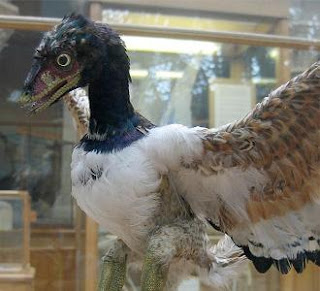
Inaccurate Archaeopteryx model at Creation Museum

For your amusement and entertainment I present: the Jurassic Pigeon! This model is intended to be Archaeopteryx. It was produced by Buddy Davis, for the Answers in Genesis Creation Museum, which has its Grand Opening on Monday, May 28. The image is available full size at Ken Ham's blog: "A steady diet" of AiG materials and souls saved.

For all you real biologists and paeontologists out there, please add comments for this article! I'm going to describe some funny features of the model, but I know I am missing more details. If you have any expertise, or if you want to try out your amateur knowledge, please help. I think also that this model was featured in someone else's blog or article, and I have not been able to find it. Please give the link so I can credit you as well.

More information about Archaeopteryx in a nicely accessible form is available from talkorigins at All About Archaeopteryx. This is now a bit dated, but good for specifically refuting creationist confusions.

I have a relevant previous blog article on The Evolution of Wings.

There are many other pages on this famous fossil. See pages at Enchanted Learning, or at Berkeley Museum of Paleontology, or at Wikipedia.
Davis' model looks a lot like a large pigeon, with two exceptions. Davis has added the claws on the wings, and given it a tail – both valid features of Archaeopteryx.

But the head! What a mess! Archaeopteryx did not have a beak. Its head was that of a small dromaeosaur, with a dinosaur snout well supplied with teeth. The neck in Archaeopteryx, as in dinosaurs, attaches to the skull from the rear. Davis has mounted the head with the neck attaching from below, as in modern birds. Archaeopteryx has nasal openings at the end of the snout, like a dinosaur. Davis has a beak. Here is a side by side comparison with the model at the Oxford University Museum of Natural History.


The head is the funniest part of the model, but the legs are also pretty bad. Archaeopteryx had quite long legs, and well equipped with feathers. Indeed, there is a possibility that the flight of Archaeopteryx used its legs in flight as well as forearms; unlike birds that use only the arms. (cf Science News online, Sep 23, 2006.) Davis seems to have put spindly little bird legs onto the model, that vanish up into the thick nest of feathers around the body. The reality is that Archie had prominent and muscular legs, with their own feathers.

And of course the body of Davis' model is a nice plump pigeon. Archie was a predator, lean, mean, and fast.

For comparison, here are some more credible reconstructions of Archaeopteryx. Each one is linked back to the source.


Wikipedia on Archaeopteryx

There has recently been some interest in the feet of Archaeopteryx. It has been traditional that reconstructions have given Archie a fully reversed hind toe. Birds use this structure for perching, and though it is hard to see on Davis' model, he seems to have this bird like foot.

In fact, Archie's feet were much more like those of a theropod dinosaur, with a hyperextended toe complete with killing sickle claw. There's a discussion at Earliest Bird Had Feet Like Dinosaur, Fossil Shows (National Geographic News, Dec 2005) which in turn refers to "A Well-Preserved Archaeopteryx Specimen with Theropod Features", by G. Mayr, B. Pohl, D. S. Peters, in Science Dec 2, 2005, Vol. 310, Iss. 5753; pp. 1483-6.

This paper describes a number of features of Archaeopteryx apparent in the tenth known fossil. The basic conclusion, apparent in the title, is that Archaeopteryx has a lot of features linking it to theropod dinosaurs. The paper includes a detailed consensus tree of relationships, consistent with the widely accepted notion that Archaeopteryx was a sister group to modern birds. The tree identifies a group "Paraves", which divides into two groups. One includes Archaeopteryx and Rahonavis; the other is marked Deinonychosauria, which then splits into Troodontidae and Dromaeosauridae. The latter includes animals like Velociraptor, made famous by the Jurrasic Park movie. And that is the group most closely related to modern birds. *

Creationists can't handle this consistently. There are basically two responses. One set of creationists treat Archaeopteryx as a bird, with some minor differences like claws on the wings and teeth in the beak. The other approach focuses on the fact that Archaeopteryx is not directly ancestral to modern birds, and spins that into a denial of any association at all. Both arguments are symptomatic of a stolid cement headed stupidity.

The former approach manages to plumb slightly deeper depths of idiocy. Predictably, this is the approach chosen by Answers in Genesis, for their absurd museum.


Update. This article is part of a blog carnival on The Creation Museum. Go check it out; 75 differents links with brief extracts, all about this fantastically absurd museum. Thanks to PZ Myers for the hard work of putting it all together, and for the imeptus to write my own article on the subject. I have also fixed a broken link to the talkorigins archive.


* Update, May 29. The phylogeny proposed by Mayr et al., which I cited above, is contentious. A recently published phylogeny is available at A new look at the Phylogeny of Coelurosauria (Dinosauria: Theropoda) by Phil Senter, in Journal of Systematic Palaeontology, doi:10.1017/S1477201907002143, published online May 14 2007. This supports the more usual view that Aves, including Archaeopteryx, is a monophyletic group that does not include Troodontidae or Dromaeosauridae. The combined group is called Paraves, a taxon named in 1997. Locating a few well known dinosaurs within Senter's phylogeny gives the following relationships.

I'd appreciate any further details or corrections or concerns with the material I have presented.

Read the full post...

Tuesday, 15 May 2007

Explaining theistic evolution to Martians

PZ Myers has requested an explanation of the difference between theistic evolution and intelligent design. Furthermore, he suggests that we imagine he's a Martian. This is a constructive suggestion, and I shall give it my best shot. I'm not sure what Martians are really like, so I'll presume that they are like PZ.

Background on Martians, for any human readers

Martians have good understanding of the natural world, and good appreciation of the areas where we don't have answers as yet. Technologically and scientifically, Martians are pretty much at the same position as humanity. Martians are social animals; who form stable family groups, and also like to engage constructively with others of their species. They are willing to put significant time and energy into their wider society, and put high importance on the well being of their fellows. They are curious about the world and seek to learn about it, and to share what they have learned, with passion and enthusiasm.

However, Martians have no concept of religion, or of a supernatural, or of Gods. They've heard about such things, since they regularly tap into the broadcasts we humans have been making; but this is one aspect of human society that Martians just don't get. They are inclined to think that humans who believe such things are, well, "a couple of tentacles short of a full cranium".


Welcome and Introduction

Honourable Ambassador, welcome to the third planet. You are aware, of course, that humans have a range of curious notions about the nature of the world. One common belief, in which you have expressed particular curiosity, is the notion of "God", an invisible intangible powerful conscious being. The reasons people believe such a thing are many and varied. None of them are particularly good. Humans are prone, from time to time, to have strange beliefs without any good evidence. A few other examples: We were meant to be together. I can still drive just fine. This shirt brings me luck.

The diversity of human beliefs about "God" is enormous, and many of them are in direct conflict with easily confirmed common knowledge about the world. Other beliefs about God are technically consistent, in the sense that they don't seem to make any empirical difference to anything we can effectively observe or sense.

Many people believe that such a being is responsible for making the world. The term "creator" is used, suggesting that in some way the putative intangible "God" causes other more tangible things to exist in the forms we can observe. This belief in a creator takes an enormous variety of forms.

Although none of these beliefs are well founded, it has still been convenient to classify some common themes. I shall attempt to describe three, and explain the utility for these broad classifications.

Creationism

This term is used for a belief that "God" used an act of special intervention to create things, in particular the universe, this particular planet, and the first living things. This belief has real substantive content (albeit ludicrous). It represents the creative act as a genuine alternative to the conventional discoveries we have made about how things were actually formed. It is common to hold that the interventions occurred comparatively recently, though there are exceptions. Creationists reject the notion that the form of living organisms, and humans in particular, can have evolved. They reject the discovery of biological evolution, the discovery that contemporary living forms developed from radically different ancestors by the agency of cumulative variation along a lineage modulated by natural selection.

Intelligent design

This is a form of creationism that has been shorn of any actual content. For political reasons they avoid explicit mention of God. In an effort to avoid refutations they avoid making any positive claims about, well, anything at all. They do reject the efficacy of natural processes and biological evolution in particular as the means by which living things take the forms we now observe, and their reasons and arguments are the same as those used by other creationists. They hold that living forms must have been "intelligently designed" instead – though they have no actual account of what that might mean. It's basically conventional creationism cut down to remove anything positive or any explicit mention of God.

Theistic evolution

The creationist position can be pared down even further, so that nothing is left except the statement that God is creator. To this, theistic evolution makes one new addition – explicit recognition of the validity of evolutionary biology. The theistic evolutionist considers that natural processes like evolution are the means by which the creator creates. How this works is unclear, and it is not something that is argued from an empirical basis.

Why distinguish intelligent design and theistic evolution?

Although intelligent design is a form of creationism, the same cannot be said for theistic evolution – at least given the ways of using terms I have described here. Creationism, including intelligent design, sees the action of God as something that is contrasted with the action of natural processes. Creationism is incompatible with evolutionary biology, because it is presented as an alterative to evolutionary biology.

Theistic evolution, on the other hand, recognizes evolution as a valid description of how living things came to have their currently observed physical forms. Theistic evolution sees God as in some sense responsible to the establishment of the evolutionary process itself; either by setting up initial conditions so as to enable evolution, or else by continuously maintaining the existence of a universe in which evolution can occur. There is no evidence for either proposition; but theistic evolution is not claimed to be a scientific model based on evidence; but rather a nebulous faith statement about some unevidenced responsibility of "God" for the ongoing operation of all aspects of the natural world.

The reason this distinction is of any interest to those who do not believe in God arises largely from a concern about science education.

Creationism, including intelligent design creationism, incorporates an explicit rejection of basic science. The cut down version of creationism called intelligent design is specifically tailored to avoid the social protections we have set up for education. Advocates for these notions are active in trying to degrade and distort science education, by inclusion of various trivially fallacious and pseudoscientific notions under the basically dishonest guise of alternative scientific models. They necessarily see the teaching of basic science as teaching a denial of their own beliefs.

Theistic evolution, on the other hand, is an unscientific add-on to conventional science. Most theistic evolutionists recognize that this add-on is not science, and do not seek to include it in the teaching of science. They do not regard the teaching of conventional science as a denial of their own beliefs.

Two design arguments

A convenient way to identify this subtle but significant distinction is to look at the perspective of the two groups on design. The arguments or apologetics given for beliefs about design and a creator come in two diametrically opposite forms.

Intelligent design and creationism claim that the natural processes studied by science are inadequate as an explanation for complex living things, and on that basis they claim that some other better explanation is required, which they label "design".

Theistic evolution considers that the natural processes studied by science are extraordinarily effective as an explanation for complex living things, and on that basis they claim that this fecundity was established by design.

One group sees design in the putative inadequacy of natural processes. The other sees design in the efficacy of natural processes.


Update: May 16 12:45. On reflection, I think the term "theistic evolution" is potentially confusing. What I really mean by that is "theism and evolution". The actual scientific descriptions of evolution remain totally unchanged. It's not a different theory of evolution; but the position of accepting perfectly conventional evolutionary biology while also being a theist. How theism can be consistent with evolutionary biology is a problem for theology, or for general theism/atheism debates. Such debates are fine by me; I engage in them also.

I was prompted to make this remark by reading these comments left at another blog, by Tyler DiPietro. I've also acknowledged below in comment #9.
Read the full post...

Monday, 14 May 2007

Gervais explains Creationism from the source


Lots of people have picked up on this, and rightly so. Very funny. An excellent comic considers creationism. I sometimes think a good belly-laugh achieves more than any of our scholarlary demolitions. Part two below the fold.


Read the full post...

Sunday, 6 May 2007

Is D'Souza really redefining evolution?

Conservative USA blogger and writer Dinesh D'Souza isn't afraid of Darwin. According to D'Souza, this is not because Darwin can be easily refuted; but because actually Darwin is perfectly compatible with Christian belief in design. He says:

I know many on the right, especially the Christian right, are scared of Darwin. Even intellectual magazines like Commentary seem to have adopted an anti-Darwin position. This has enabled many on the left, as well as the professional atheists like Richard Dawkins and Sam Harris, to portray conservative Christians as yahoos. Sometimes we do come across that way.

In my forthcoming book "What's So Great About Christianity" I will show why, contrary to the claims of Dawkins and company, Darwinian evolution does not undermine the design argument for God. On the contrary, the latest findings of modern science have greatly strengthened that argument. Paley was right and Dawkins is wrong.
This has been picked up by a number of prominent bloggers. Pharyngula is unimpressed, at The rebranding of Intelligent Design. He says:

The new strategy is to embrace the word "evolution". Ask them if they believe in evolution, and they will happily declare that "Yes, I believe in 'evolution'!" Unfortunately, what they call "evolution" is not evolution as evolutionary biologists understand it. If they're willing to redefine science, what's to stop them from redefining mere evolution to suit them?
Pharyngula's title got it right. D'Souza is trying to rebrand design, but without letting on that this is what he is doing. But is D'Souza actually redefining evolution? Not that I can see.

Paley's notion of design

D'Souza is playing fast and loose with the notion of design. Paley's arguments on natural theology dealt specifically with the forms of living things. His famous book, first published in 1802, is Natural Theology, Or, Evidences of the Existence and Attributes of the Deity. This includes the notorious "watchmaker" argument, which is the argument that has been picked up by the modern intelligent design movement. Put simply, anything that complex needs a designer. This argument was exploded by Darwin's insights on the origin of species.

The modern Intelligent Design movement picked up the shreds of this now useless argument, and by virtue of reeking incompetence at elementary science they tried to prop up the corpse with a lot of claims about new scientific theories. No science was actually involved, of course; just lots of bafflegab, and repackaging of conventional creationist arguments. This charade has been thoroughly exposed for anyone with the wit to see it.

D'Souza thinks Paley got it right. But Paley does much more than propose design. He gives an actual argument for design, and he speaks specifically of design of the forms of living things themselves. And in this, Paley got it wrong.

For instance, on page 468 (12 ed) of his book, Paley considers some difficulties with his view.

The TWO CASES which appear to me to have the most of difficulty in them, as forming the most of the appearance of exception to the representation here given, are those of venomous animals, and of animals preying upon one another. These properties of animals, wherever they are found, must, I think, be referred to design; because there is, in all cases of the first, and in most cases of the second, an express and distinct organization provided for the producing of them. Under the first head, the fangs of vipers, the stings of wasps and scorpions, are as clearly intended for their purpose, as any animal structure is for any purpose the most incontestably beneficial. ...
The remainder of the chapter makes fascinating reading. Paley gives some mitigating considerations, and a look at the whole problem of evil, and also, interestingly, a consideration of a role for chance and contingency along with design.

The critical point to bear in mind is this: Paley is looking at the specific organs and adaptions of living things. In Paley's view, the form of such organs can only be explained by design. Darwin showed that this is wrong; finely adapted organs can also be explained by natural selection.

The modern intelligent design movement is perfectly correct to see evolution and design as being two radically different explanations for the finely adapted forms of living complexity. They can't both be right, and this design argument is most certainly wrong.

Another view of design

At this point, we come to a subtle distinction. Darwin certainly exploded the line of reasoning used by Paley, but he did not explode the conclusion that the natural world is established by the design of a deity. Darwin left in smoking ruins the best positive argument from the natural world to a deity. He did not actually proceed to refute the deity itself.

It seems hard for many atheists to get their head around this point: but there are many Christians actively at work in scientific research into the natural world, and who accept without quibble or distortion all the basic empirical facts of evolutionary biology as conventionally understood by mainstream science. Christians are a minority amongst working scientists, but there are still a substantial number.

Christians invariably have some kind of notion whereby the natural world is God's creation. For Christians active in conventional science, this usually means that evolution itself is an intended consequence of how the designer set up the cosmos. An interesting example of this perspective is the famous evolutionary biologist Theodosius Dobzhansky. Dobzhansky's well known essay,
Nothing in Biology Makes Sense Except in the Light of Evolution is actually about science and religion, and it expresses basically a kind of theistic evolution. He says:

The organic diversity becomes, however, reasonable and understandable if the Creator has created the living world not by caprice but by evolution propelled by natural selection. It is wrong to hold creation and evolution as mutually exclusive alternatives. I am a creationist and an evolutionist. Evolution is God's, or Nature's method of creation. Creation is not an event that happened in 4004 BC; it is a process that began some 10 billion years ago and is still under way.
This is a variant of a common theme amongst Christians who are active in science. They hold that the entire natural world is established by design, and that any study of natural processes is study of that design.

This perspective is, of course, not provable and (usually) not falsifiable. It is not a scientific model. This is invariably recognized by its advocates. It may not be a good fit with popular religion, but Christianity is extremely diverse in any case. Dobzhansky, for example, was a devout Russian Orthodox Christian, but he was by no means conventional in his beliefs.

Whether this perspective is a fit with traditional religion is debatable. My own feeling is that we can see this much, at least... it has been a traditional belief all down the centuries that all natural processes are established by God. This foundational belief has been maintained many many Christians even as our understanding of those processes has developed.

Don't Redefine Evolution

We don't have to agree with Dobzhansky. But it would be rash to say that his view was inconsistent with evolution, or that he redefined evolution! As one of the major developers of the "New Synthesis" of evolutionary biology with genetics in the 1960s, Dobzhansky has an excellent claim to being one of those who established the definitions of evolution that we use today!

D'Souza recognizes that taking an explicit anti-Darwin position makes you look like a yahoo. As far as I can tell he's recognizing Darwinian evolution as it is conventionally defined. I see no flagrant errors in the details of evolutionary biology involved; and no redefinition.

The explicitly anti-Darwin position of the modern Intelligent Design movement so popular with D'Souza's fellow religious conservatives is a position of breathtaking inanity, fostered by culpable ignorance and calculated dishonesty in its public defenders. The real risk from attempts to rebadge intelligent design is the problem of the big tent. The risk is that they'll say one thing to one audience and another for a different audience, and try slide anti-Darwinian design of specific forms into the arena under the cover of a vague belief in a creative design underlying the whole cosmos.

D'Souza is, as far as I can tell, recognizing the validity of evolution, but arguing that it's a part of the whole design. That's a position that can and should be argued. But let's not argue it by redefining evolution ourselves!

This has nothing to do with wanting atheists to keep silence, or with rolling over and accepting the validity of religion, or with avoiding offense to believers who happen to be allies in the fight against creationist pseudoscience.

Evolutionary biology makes no mention of plans, or designs, or Gods. We have no need of that hypothesis. The same is true of meteorology, geology, physics, chemistry or any other science. There is not even an additional clause to say "there's no God who set this up". To argue for or against God's existence can use arguments relating to empirical science, but they have to go further than this and into some metaphysics.

Distorting science to insert our own metaphysics is bad because it distorts science. It is bad when done by believers, and it is bad when done by unbelievers.

Read the full post...

Monday, 30 April 2007

"Darwin is dead" is dead

Last year I had a look through the "Darwin is Dead" blog carnival.

It was rather a mess. The first carnival was in February 2006; and evolutionists all over the blogsphere had a lot of fun picking through the five entries to hold up selected choice bits of nonsense for special ridicule.

The second carnival was in April. It was rather surreal. There were seven entries. Three were actually parodies by evolutionists. Two were articles from the websites of AiG, and ICR. Only two were from genuine creationist blogs.

There have been two more carnivals since then. The carnival organizer appeared to have bowed to the inevitable, and accepted a couple of entries from serious evolutionary bloggers. As before, the number of creationist entries remained small; and most of those continued be ordinary articles from professional creationist websites, plus one or two actual creationist bloggers.

I came across it again just now while surfing, and must report… "Darwin is Dead" is dead. The carnival only ran the four times. May it rest in peace. (Guffaw)

Read the full post...